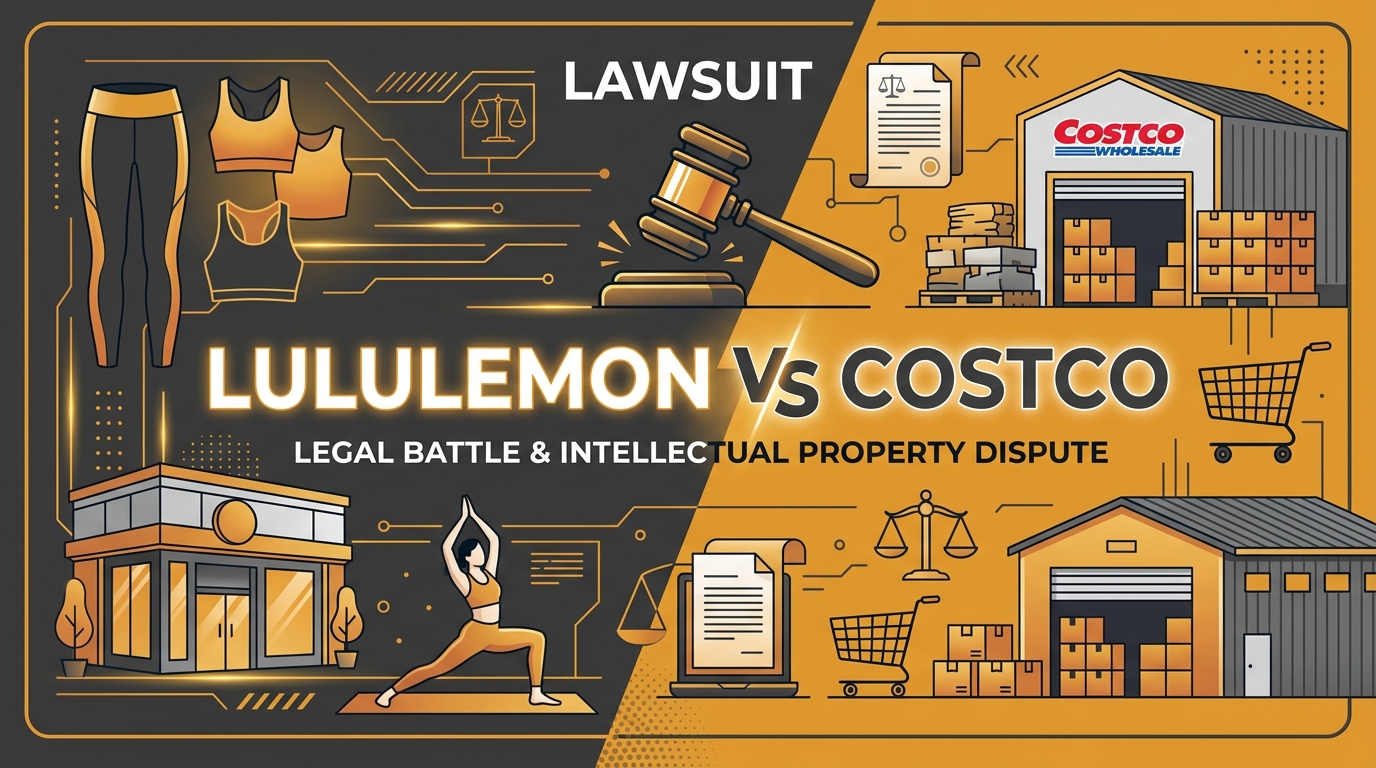
The Lululemon Costco lawsuit centers on allegations that Costco Wholesale Corporation sold apparel items closely resembling signature Lululemon products, including elements of its Scuba hoodies, Define jackets, and ABC pants. Lululemon Athletica Canada Inc. and related entities filed the complaint on June 27, 2025, in the U.S. District Court for the Central District of California (Case No. 2:25-cv-05864).
The suit asserts that certain Costco-sourced products, sold under brands such as Kirkland Signature, Danskin, Spyder, Jockey, and Hi-Tec, infringed Lululemon’s trademarks, trade dress, and design patents. Lululemon claims these items created a likelihood of consumer confusion and harmed its brand goodwill and sales.
As of late May 2026, the case has narrowed substantially. Through a series of stipulations approved by the court, claims involving multiple product lines, including Kirkland Signature performance pants and a Spyder women’s yoga jacket, have been resolved and dismissed with prejudice. Litigation continues on a narrower set of claims tied to at least one men’s zip-up jacket. Court-ordered mediation is scheduled to conclude by July 31, 2026, with a jury trial currently set for March 2027 if needed.
This dispute highlights critical issues at the intersection of intellectual property protection, retail competition, and consumer perception in the athleisure sector. It raises questions about how far brand owners can go to safeguard distinctive product designs and how retailers should approach sourcing and marketing affordable alternatives.
Background and Legal Context
Athleisure apparel has grown into a major retail category, driven by demand for comfortable, performance-oriented clothing that transitions from workouts to everyday wear. Lululemon built its reputation on premium positioning, community-focused marketing, and specific product designs that consumers associate with the brand.
In recent years, “dupe culture” has gained prominence through social media platforms, where users share affordable alternatives to higher-priced items. Retailers, including warehouse clubs like Costco, have responded by offering private-label or sourced products at lower prices to meet value-seeking customers.
Lululemon has pursued intellectual property enforcement in the past to protect its designs and branding. The current Lululemon Costco lawsuit follows this pattern but targets a major retailer directly rather than smaller copyists.
Under U.S. law, fashion and apparel receive protection through multiple overlapping regimes:
- Trademarks protect words, names, symbols, or devices that identify the source of goods (Lanham Act, 15 U.S.C. §§ 1051 et seq.).
- Trade dress protects the overall visual appearance or image of a product when it serves as a source identifier, provided the features are distinctive and non-functional.
- Design patents protect new, original, and ornamental designs of articles of manufacture (35 U.S.C. § 171). These provide narrower but often stronger protection for specific aesthetic features, independent of whether consumers recognize the source.
Lululemon holds registered trademarks, including for the SCUBA mark used on certain hoodies and sweatshirts, as well as design patents covering ornamental aspects of jackets and related items. The complaint also references specific colors and design elements alleged to function as protectable trade dress.
Prior to filing, brand owners typically monitor retail channels, document similarities, and often send cease-and-desist communications. When negotiations fail, federal court litigation becomes the next step for claims arising under federal trademark and patent statutes.
Key Legal Issues Explained
The Lululemon Costco lawsuit raises three primary intellectual property claims, each with distinct legal standards and practical implications.
Trademark Infringement
Lululemon alleges infringement of its registered SCUBA trademark and related branding elements, including references to specific colors such as Tidewater Teal in marketing or product descriptions. Under the Lanham Act, a plaintiff must show that the defendant’s use of a mark is likely to cause confusion as to the source, affiliation, or sponsorship of the goods. Courts in the Ninth Circuit consider factors such as the strength of the plaintiff’s mark, the degree of similarity between the marks, the relatedness of the goods, marketing channels, and evidence of actual confusion or the defendant’s intent.
Lululemon contends that Costco’s use of similar terminology and product positioning creates an improper association with authentic Lululemon items. Costco has denied infringement in its responsive pleadings.
Trade Dress Infringement
This forms a central pillar of the case. Trade dress encompasses the total image of a product, including features such as size, shape, color combinations, texture, and ornamental design elements, when those features identify the source and are non-functional. To prevail, Lululemon must demonstrate that its claimed trade dress (for example, distinctive curvilinear lines, hood shapes, or overall silhouettes on jackets and pants) has acquired secondary meaning, meaning consumers associate it primarily with Lululemon, and that Costco’s products create a likelihood of confusion.
Proving trade dress protection in apparel can be challenging. Many design elements serve functional purposes (zippers for closure, pockets for utility, stretch fabrics for movement). The functionality doctrine limits protection for features that are essential to the product’s use or affect cost or quality. Lululemon argues that specific combinations and ornamental aspects go beyond function and serve as source identifiers.
Design Patent Infringement
Design patents protect the ornamental appearance of an article, not its functional aspects. Infringement occurs if an ordinary observer, familiar with the prior art, would find the accused design substantially the same in overall visual impression as the patented design (the test from Egyptian Goddess, Inc. v. Swisa, Inc.).
Lululemon asserts design patents covering specific jacket and hoodie configurations. Unlike trade dress, design patent protection does not require proof of secondary meaning or consumer recognition of source. This can make design patents particularly useful for fashion items with distinctive but potentially functional-adjacent aesthetics. However, the protection is limited to the specific ornamental features shown in the patent drawings and lasts for a term of years from the grant date.
The complaint includes side-by-side comparisons and references to specific accused products sold at significantly lower price points than comparable Lululemon items. Lululemon seeks injunctive relief to halt sales of allegedly infringing products, monetary damages (including lost profits), and other relief. Costco maintains that its products do not infringe and that it acted appropriately.
Latest Developments and Case Status
Since the June 2025 filing, the case has progressed through standard federal civil procedure steps, including Costco’s answer denying the allegations, limited intervention by a supplier (later dismissed), discovery, and multiple stipulations.
By May 2026, the parties reached agreements resolving claims related to several product categories. Court orders approved the severance and dismissal with prejudice of claims involving the Kirkland Signature 5-Pocket Performance Pant and the Spyder Women’s Yoga Jacket. Earlier resolutions addressed other Kirkland-branded pants and outerwear items.
These resolutions followed negotiations, including direct agreements between Lululemon and certain suppliers. The remaining active claims center on a men’s zip-up jacket (reported as the Hi-Tec Men’s Scuba Full Zip or similar).
On May 28, 2026, the court approved a stipulation extending Lululemon’s deadline to file a First Amended Complaint (limited to conforming the pleading to the remaining claims) to June 10, 2026. The case has been referred to private mediation, with proceedings to conclude by July 31, 2026. A final pretrial conference is scheduled for February 2027, and trial remains calendared for March 16, 2027, absent further resolution.
This pattern of incremental, product-specific resolutions is common in complex intellectual property cases involving multiple accused items. It allows parties to narrow disputes, reduce litigation costs, and focus resources on core contested issues while avoiding the uncertainty and expense of a full trial on every claim.
Who Is Affected and Potential Impact
Consumers
Shoppers seeking affordable athletic and athleisure wear may notice changes in product availability or marketing language at Costco and similar retailers. If confusion existed, resolution of claims could reduce the risk of misidentification between premium and value-oriented options. However, consumers generally benefit from competitive alternatives, and many “dupe” purchases reflect deliberate value choices rather than mistaken brand identification.
Retailers and Private-Label Operators
The case signals heightened risk for retailers that source or develop lookalike products. Even without copying logos, substantial similarity in overall appearance, combined with similar product names or positioning, can trigger claims. Retailers may strengthen supplier contracts with robust intellectual property indemnification clauses, implement more rigorous design clearance reviews, and exercise greater caution with descriptive marketing terms.
Brand Owners
The Lululemon Costco lawsuit reinforces the value of a multi-layered intellectual property strategy. Registering word marks, securing design patents for key ornamental features, and building evidence of secondary meaning for trade dress claims can strengthen enforcement positions. It also illustrates the practical reality that litigation often narrows through settlement rather than resulting in sweeping judicial precedent.
The Broader Fashion and Retail Industry
Outcomes in this and similar cases influence how companies balance innovation incentives with competitive pressures. Strong protection for distinctive designs encourages investment in product development. At the same time, overly broad enforcement could chill legitimate competition and consumer access to affordable options. The functionality doctrine and ordinary-observer tests help maintain this balance, though application to apparel remains fact-intensive and sometimes unpredictable.
What This Means Going Forward
The Lululemon Costco lawsuit demonstrates how brand owners can use federal intellectual property laws to challenge close copies sold through major retail channels. The substantial narrowing of claims through party agreements shows a pragmatic approach often taken in these disputes: targeted resolutions on specific products rather than all-or-nothing litigation.
For retailers, the key takeaway is the importance of proactive intellectual property diligence when developing or sourcing private-label and comparable apparel. Descriptive terms that echo protected marks, combined with visual similarities, increase exposure even if exact logos are avoided.
For brand owners, the case underscores both the power and the limitations of trade dress and design patent protection in the fashion space. Design patents can offer relatively strong, source-independent protection for ornamental features, while trade dress claims require careful documentation of distinctiveness and non-functionality.
Stakeholders should monitor several developments:
- Filing of any amended complaint by the June 10, 2026 deadline.
- Outcomes of court-ordered mediation.
- Any motions for summary judgment or further stipulations.
- Potential rulings that clarify the scope of protectable trade dress or design patent coverage in apparel.
Similar disputes involving other premium brands and value retailers will likely continue as dupe culture and competitive private-label strategies evolve. Companies on both sides benefit from understanding the distinct requirements of trademark, trade dress, and design patent law and from structuring their product development and sourcing processes accordingly.
Frequently Asked Questions
What is the Lululemon Costco lawsuit about?
Lululemon alleges that Costco sold apparel items that infringe its trademarks, trade dress, and design patents by closely resembling popular Lululemon products such as Scuba hoodies, Define jackets, and ABC pants. The claims focus on visual similarities, certain product names or color references, and overall appearance that Lululemon says creates consumer confusion.
Which products remain at issue in the Lululemon Costco lawsuit?
Through settlements and court-approved dismissals with prejudice, claims involving several product lines, including certain Kirkland Signature pants and a Spyder women’s yoga jacket, have been resolved. The remaining active claims relate to a men’s zip-up jacket.
What is trade dress, and why does it matter here?
Trade dress protects the overall look and feel of a product when that appearance identifies the source to consumers and is non-functional. In apparel cases, it can cover distinctive combinations of design elements, shapes, and ornamental features, provided they are not dictated by utility. Proving trade dress infringement requires showing distinctiveness (often secondary meaning) and a likelihood of confusion.
What are design patents, and how do they differ from trade dress?
Design patents protect the ornamental (non-functional) visual design of an article of manufacture. They do not require proof that consumers recognize the design as coming from a particular source. Infringement focuses on whether an ordinary observer would see the designs as substantially similar. They complement trade dress by offering protection based on specific aesthetic features shown in the patent.
What is the current status of the Lululemon Costco lawsuit?
As of May 2026, the case has narrowed significantly. Most product-specific claims have been resolved through stipulations and dismissals. The dispute continues on a limited basis concerning a men’s zip-up jacket. Mediation is ordered to conclude by July 31, 2026, and trial remains scheduled for March 2027 if the parties do not reach full resolution.
How might this affect other retailers or brands?
Retailers may review their sourcing, design clearance, and marketing practices more closely to reduce infringement risk. Brand owners may increase use of design patents and strengthen trade dress documentation. The case illustrates both the tools available for brand protection and the practical challenges of litigating design disputes in competitive retail categories.
Conclusion
The Lululemon Costco lawsuit provides a timely illustration of how intellectual property disputes in retail unfold in practice. Through detailed allegations supported by comparisons and registrations, Lululemon sought to protect elements of its brand identity and product designs. Costco denied infringement and the case has proceeded toward resolution on a product-by-product basis.
As claims narrow and parties engage in mediation, the dispute offers lessons on the strategic use of trademark, trade dress, and design patent protections in the athleisure and apparel sectors. It also highlights the balance courts and litigants strike between safeguarding brand investments and preserving room for legitimate competition.
Retailers, brand owners, and consumers all have interests at stake in how these issues are resolved. Developments in the coming months, including any amended pleadings or mediation progress, will provide further clarity.
You May Also Like: Amazon Lawsuit Explained: What It Means for Shoppers and Sellers