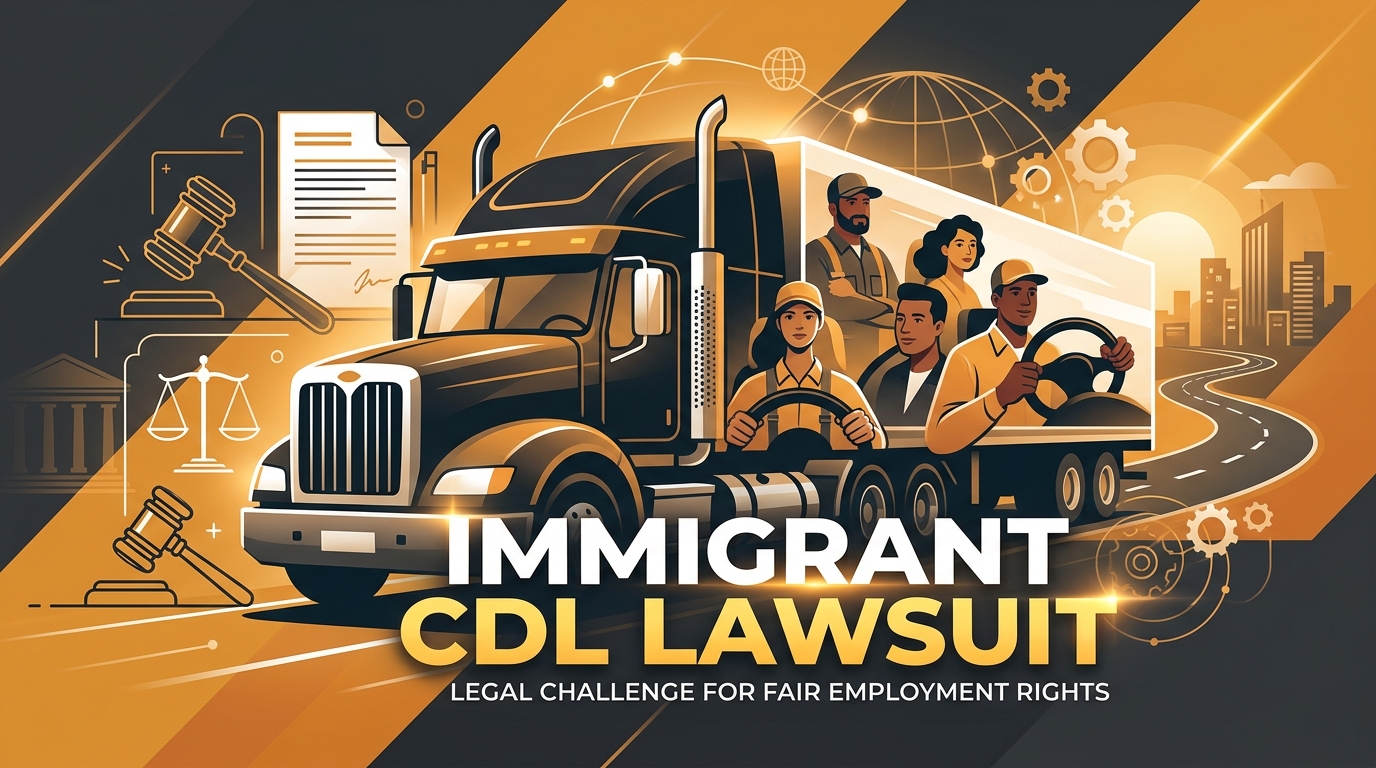
The Immigrant CDL Lawsuit centers on a federal challenge to regulations issued by the Federal Motor Carrier Safety Administration (FMCSA) that restrict eligibility for non-domiciled commercial driver’s licenses (CDLs). Filed in the U.S. Court of Appeals for the District of Columbia Circuit, the case questions whether the agency properly exercised its authority under federal motor carrier safety laws when it limited non-domiciled CDLs to U.S. citizens, lawful permanent residents, and holders of specific employment-based visas.
This dispute arose after audits revealed inconsistencies in how states issued non-domiciled CDLs to individuals domiciled abroad. The FMCSA responded with a rule designed to align licensing practices with federal standards for driver qualification and immigration verification. Plaintiffs argue that the rule exceeds statutory bounds, bypasses required procedures, and disproportionately affects lawfully authorized workers without advancing highway safety.
As of May 2026, the Final Rule remains in effect following the court’s denial of an emergency stay. The case continues on an expedited schedule, with potential implications for tens of thousands of commercial drivers, state licensing agencies, motor carriers, and the broader supply chain.
Background on Non-Domiciled CDLs and Federal Oversight
Commercial driver’s licenses are governed by the Commercial Motor Vehicle Safety Act of 1986 (CMVSA), codified at 49 U.S.C. Chapter 313, and implemented through regulations in 49 CFR Parts 383 and 384. These provisions establish minimum national standards that states must meet to avoid loss of federal highway funding. States issue CDLs, but the FMCSA sets uniform requirements for testing, medical certification, and driver qualifications.
Non-domiciled CDLs apply to drivers whose principal residence is in a foreign jurisdiction. Prior to recent changes, many such drivers could obtain CDLs by presenting valid Employment Authorization Documents (EADs) or other proof of work authorization, even if their immigration status fell outside certain visa categories. State driver licensing agencies (SDLAs) were responsible for verifying documents, but federal audits conducted in 2025 identified systemic issues. These included licenses issued beyond the expiration of work authorization, inadequate use of the Systematic Alien Verification for Entitlements (SAVE) system, and variations in state compliance with federal timelines.
High-profile accidents involving non-domiciled drivers prompted heightened scrutiny. Federal officials cited examples where licensing lapses may have contributed to safety risks, leading the FMCSA to issue guidance and later formal rulemaking. The agency’s goal was to ensure that non-domiciled CDL issuance mirrors the rigorous vetting applied to U.S.-domiciled drivers, including consular-level background checks where applicable.
The FMCSA Rule: Key Provisions and Implementation
On September 29, 2025, the FMCSA published an Interim Final Rule (IFR) titled “Restoring Integrity to the Issuance of Non-Domiciled Commercial Drivers Licenses.” A Final Rule followed on February 11, 2026, with an effective date of March 16, 2026. The regulations amend eligibility under 49 CFR § 383.71 and related sections.
Under the Final Rule, non-domiciled CLPs and CDLs may be issued only to individuals who provide evidence of lawful immigration status in one of the following categories: U.S. citizens or lawful permanent residents (as defined), or holders of H-2A (temporary agricultural workers), H-2B (temporary non-agricultural workers), or E-2 (treaty investors) visas. Other statuses, including those relying solely on EADs (such as many DACA recipients, asylees, refugees, or asylum seekers with work authorization), no longer qualify. States must query the SAVE system and limit license validity to the shorter of one year or the “Admit Until” date on the applicant’s Form I-94 or equivalent.
The rule requires the phrase “non-domiciled” to appear conspicuously on the face of the credential. It mandates in-person processing for certain transactions and directs states to downgrade or revoke licenses within 30 days upon notification of ineligibility. States unable to comply must pause issuance of non-domiciled credentials until they demonstrate adherence. Existing licenses issued properly under prior guidance are generally not subject to immediate revocation, but renewals, upgrades, or transfers require compliance with the new standards.
FMCSA officials described the changes as necessary to close gaps identified in Annual Program Reviews (APRs) and to fulfill the agency’s statutory mandate to promote commercial motor vehicle safety. The agency rejected calls for broader eligibility, stating that consular vetting for the permitted visa categories provides stronger safeguards than domestic EAD-based processes.
The Immigrant CDL Lawsuit: Parties, Procedural History, and Claims
The Immigrant CDL Lawsuit, formally Jorge Rivera Lujan et al. v. FMCSA (and consolidated cases), was filed in the D.C. Circuit. Lead plaintiff Jorge Rivera Lujan is a DACA recipient and longtime truck driver. Co-plaintiff Aleksei Semenovskii holds asylum-seeker status. Unions including the American Federation of State, County and Municipal Employees (AFSCME) and the American Federation of Teachers (AFT) joined through Public Citizen Litigation Group.
An earlier challenge targeted the September 2025 IFR. The D.C. Circuit issued an administrative stay in November 2025, pausing enforcement pending further review. After the agency issued the Final Rule, plaintiffs filed a new petition for review on February 12, 2026. They sought an emergency stay of the March 16 effective date, which the court denied. On May 5, 2026, the court again declined to pause enforcement while expediting merits briefing. Oral argument is scheduled for later in 2026.
Plaintiffs contend that the rule violates the Administrative Procedure Act (APA) in multiple respects. They argue the IFR bypassed required notice-and-comment procedures without sufficient justification for the “good cause” exception. On the merits, they claim the agency acted arbitrarily and capriciously by failing to adequately support its safety rationale with data specific to the excluded populations, disregarding the economic impact on the trucking industry, and failing to consider less restrictive alternatives. The suit also alleges that the categorical exclusion of certain work-authorized immigrants lacks a rational connection to the CMVSA’s safety-focused purpose.
FMCSA maintains that the rulemaking falls within its broad discretion to set CDL standards. The agency points to audit findings of widespread noncompliance and the need for uniform, verifiable immigration status checks. It asserts that the rule does not affect underlying work authorization but simply aligns CDL eligibility with federally vetted statuses that include enhanced background screening.
Parallel State-Level Litigation and Enforcement Actions
The federal rule has intersected with state-specific disputes. In California, the DMV faced pressure to address approximately 17,000 to 20,000 non-domiciled CDLs issued with alleged clerical or compliance errors. After cancellation notices were sent, the Sikh Coalition, Asian Law Caucus, and other groups filed a class-action lawsuit in Alameda County Superior Court. In February and March 2026, the state court ruled that the DMV must allow affected drivers to reapply and reissue licenses where appropriate, citing failures to provide adequate due process under state law.
The federal government directed California to pause issuance pending compliance, withholding certain federal highway funds. California has filed its own challenge against the Department of Transportation. Similar audits and corrective action plans have affected SDLAs in multiple states, leading to temporary pauses in non-domiciled CDL processing in some jurisdictions.
Separate litigation, such as actions by Florida’s attorney general against certain states, has highlighted interstate tensions over licensing standards and public safety. These cases underscore the tension between federal preemption in CDL standards and state authority over driver licensing.
Legal Principles at Stake
The Immigrant CDL Lawsuit implicates core administrative law doctrines. Under the APA (5 U.S.C. § 706), courts review agency actions to ensure they are not arbitrary, capricious, or contrary to law. Chevron deference principles, though narrowed in recent Supreme Court decisions, still guide analysis of statutory interpretation in technical areas such as transportation safety. The CMVSA grants the Secretary of Transportation (and by delegation, FMCSA) authority to prescribe minimum standards for CDL testing and issuance, including requirements related to driver qualifications.
Immigration status verification intersects with federal immigration law administered by the Department of Homeland Security. The SAVE system serves as the designated mechanism for SDLAs to confirm lawful presence. The rule does not alter employment authorization itself but conditions CDL issuance on specific, verifiable immigration categories. Courts have historically deferred to FMCSA on safety-related licensing criteria while scrutinizing procedural compliance.
Practical Impacts on Drivers, Employers, and the Industry
The rule affects an estimated 194,000 to 200,000 non-domiciled CDL holders, many working in trucking, school transportation, transit, and delivery services. Drivers whose statuses fall outside the permitted categories face non-renewal upon expiration, potentially leading to job loss. Employers must verify compliance during hiring and credential updates, with carriers operating across state lines navigating varying SDLA implementation timelines.
Industry groups have expressed concern about exacerbating existing driver shortages. Trucking associations note that immigrants already comprise a significant portion of the workforce and that abrupt restrictions could disrupt supply chains. Conversely, safety advocates and some carrier representatives support tighter standards to reduce risk and ensure consistent enforcement.
States face compliance costs, potential funding penalties, and operational pauses. Motor carriers may need to adjust fleet planning, training programs, and recruitment to prioritize eligible drivers. Individual drivers in affected categories may seek alternative visa pathways or transition to non-commercial roles.
Current Status and Future Outlook
As of May 2026, the Final Rule is enforceable nationwide. The D.C. Circuit’s May 5 decision cleared the path for implementation while the court considers the merits on an accelerated timeline. Plaintiffs must file their opening brief by mid-June 2026, with FMCSA’s response due in July. A final ruling could come later in the year or in 2027, subject to possible Supreme Court review if the parties appeal.
In the interim, SDLAs continue to apply the new eligibility criteria. Affected drivers retain the ability to operate until their current credentials expire, provided no downgrade is triggered. Ongoing audits and corrective action plans will shape state-level enforcement. Legislative proposals in Congress or executive actions in future administrations could alter the landscape, though any changes would require formal rulemaking.
Conclusion
The Immigrant CDL Lawsuit represents a contest between federal authority to set uniform commercial driver standards and the practical realities faced by lawfully present workers who rely on CDLs for their livelihoods. It highlights longstanding tensions in the intersection of immigration policy, transportation safety, and administrative procedure. While the FMCSA has defended the rule as essential to public safety and regulatory integrity, challengers maintain that it sweeps too broadly without sufficient justification or process.
Stakeholders across the commercial motor vehicle sector should monitor developments closely. Employers, drivers, and licensing agencies will need to adapt to the current framework while preparing for potential judicial or policy shifts. This article is for informational purposes only and does not constitute legal advice. Individuals facing specific licensing or employment issues should consult qualified counsel or their state driver licensing agency for guidance tailored to their circumstances.