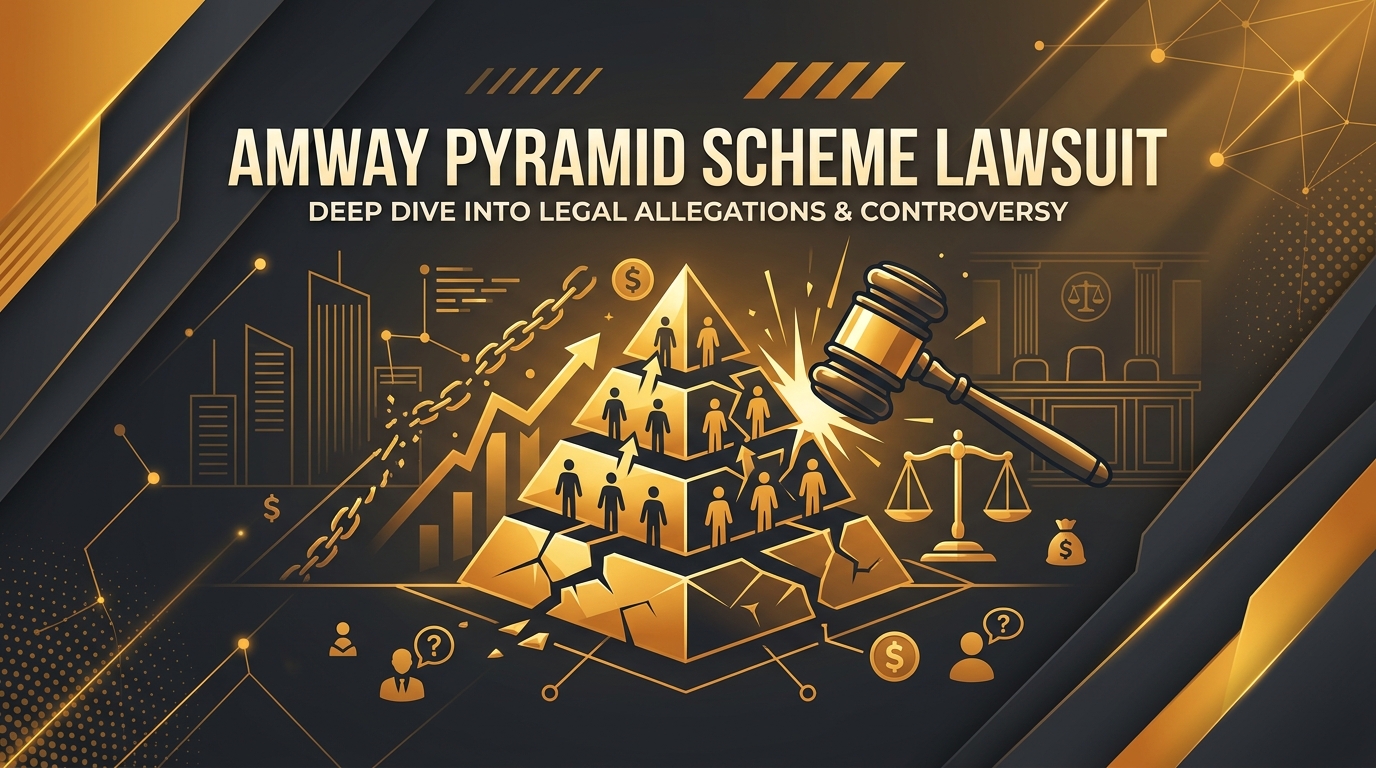
The Amway Pyramid Scheme Lawsuit has drawn significant attention from consumers, regulators, and legal observers over the years. This high-profile class action, filed in 2007 against Amway (then operating as Quixtar in the United States) and certain top-level distributors, alleged that the company’s multi-level marketing (MLM) model operated in a manner resembling an illegal pyramid scheme. Plaintiffs claimed fraud, racketeering under the Racketeer Influenced and Corrupt Organizations (RICO) Act, and deceptive practices that prioritized recruitment and internal tool sales over genuine retail sales to end consumers. Although the case settled in 2010 without an admission of wrongdoing by Amway, the Amway Pyramid Scheme Lawsuit continues to prompt broader questions about the legality and transparency of certain MLM business practices.
This article examines the legal context of the Amway Pyramid Scheme Lawsuit, relevant regulatory frameworks, and its implications for participants and the direct-selling industry. It provides factual background drawn from court records and regulatory decisions to help readers understand the issues at stake. This article is for informational purposes only and does not constitute legal advice.
Background and Legal Context
Multi-level marketing companies like Amway have operated in the United States for decades, relying on independent business owners (IBOs) who sell products directly to consumers while also recruiting others into the network. Compensation in legitimate MLMs is generally tied to retail sales of goods or services to ultimate users outside the distributor network. In contrast, illegal pyramid schemes compensate participants primarily for recruiting new members, with little or no emphasis on actual product sales. This distinction forms the core of federal and state regulatory scrutiny.
The foundational legal precedent for evaluating such plans comes from Federal Trade Commission (FTC) decisions in the 1970s. In the landmark 1979 ruling in In re Amway Corp. (93 F.T.C. 618), the FTC examined Amway’s operations after issuing a complaint in 1975. An administrative law judge determined that Amway did not constitute an illegal pyramid scheme under the statutory definition. The decision highlighted Amway’s safeguards, including requirements that distributors sell to at least 10 retail customers per month (the “10-customer rule”), resell at least 70 percent of inventory purchased each month (the “70-percent rule”), and maintain a buyback policy for unsold merchandise. These measures were viewed as evidence that compensation was linked to legitimate retail activity rather than pure recruitment.
The FTC did, however, order Amway to cease certain practices, including price fixing among distributors and misrepresenting the likelihood of financial success for the average participant. The ruling emphasized that MLMs must demonstrate that products are sold to consumers outside the network and that participants are not induced to buy inventory primarily to qualify for commissions or advancement.
Subsequent state laws and federal guidance have built upon this framework. Many states, including Michigan (where Amway is headquartered), have enacted anti-pyramid promotion statutes that prohibit compensation plans where earnings derive primarily from recruitment fees rather than product sales. The FTC has continued to monitor MLMs through consumer protection actions and guidance documents, stressing the importance of clear income disclosures and prohibiting deceptive earnings claims.
The 2007 class action that became known in public discussions as the Amway Pyramid Scheme Lawsuit was filed in the U.S. District Court for the Central District of California. Plaintiffs, former independent business owners, alleged that the company and certain high-level distributors operated an illegal pyramid scheme. They claimed that the business model emphasized the sale of motivational tapes, books, and training materials (often referred to as “tools” or “business support materials”) within the distributor network, rather than retail sales of Amway products such as household cleaners and nutritional supplements to non-distributors. The suit further asserted violations of RICO, fraud, and unfair business practices under California law.
Amway denied the allegations and maintained that its plan complied with the standards established in the 1979 FTC decision. In November 2010, the parties reached a settlement. Amway agreed to pay $34 million in cash and provide an additional $22 million in products, for a total economic value the plaintiffs’ attorneys described as approximately $150 million when including business practice changes. The settlement was approved by the court and covered claims from participants active between 2003 and 2010. As is common in such resolutions, Amway did not admit liability or wrongdoing.
Key Legal Issues Explained
At the heart of the Amway Pyramid Scheme Lawsuit and similar cases lie several core legal concepts that courts and regulators apply to distinguish lawful MLMs from illegal pyramids.
First, the Koscot test, derived from the FTC’s 1975 decision in In re Koscot Interplanetary, Inc. (86 F.T.C. 1106), defines a pyramid scheme as one in which participants pay money to the company in return for the right to recruit others, where the primary incentive is the recruitment fee rather than the sale of products. Compensation must be tied to retail sales for the plan to be legitimate.
Second, income representations and disclosures are governed by Section 5 of the FTC Act, which prohibits unfair or deceptive acts or practices. MLMs must avoid misleading prospective participants about potential earnings. The FTC has repeatedly emphasized that claims of “financial freedom” or high income must be substantiated and representative of the typical participant. Amway, like other MLMs, now publishes annual income disclosure statements showing that the majority of IBOs earn modest amounts or incur net losses after expenses.
Third, inventory loading and internal consumption issues frequently arise. Critics of certain MLM models argue that when distributors are encouraged to purchase large quantities of products or tools primarily to qualify for bonuses or advancement (rather than to meet genuine consumer demand), the plan can resemble a pyramid. Amway has long maintained policies designed to prevent this, including the 70-percent rule and inventory repurchase guarantees.
RICO claims, as alleged in the Amway Pyramid Scheme Lawsuit, add another layer. The federal Racketeer Influenced and Corrupt Organizations Act allows civil suits for damages when a pattern of racketeering activity (such as mail or wire fraud) is used to conduct an enterprise. In MLM litigation, plaintiffs sometimes argue that deceptive recruitment and tool sales constitute such activity.
Procedurally, these cases often begin as individual complaints or proposed class actions. Courts evaluate motions to dismiss, class certification, discovery, and potential summary judgment before trial or settlement. Appeals may follow, and regulatory agencies such as the FTC or state attorneys general may investigate parallel matters.
Latest Developments or Case Status
While the 2010 settlement resolved the specific class action filed in 2007, questions about Amway’s business practices have persisted in legal and regulatory discussions. Amway has faced additional litigation in subsequent years, including matters related to the classification of IBOs as independent contractors rather than employees. For example, a 2020 case in California challenged Amway’s classification practices under state labor laws, though it did not center on pyramid scheme allegations.
Regulatory oversight of the broader MLM industry has evolved. The FTC has issued updated consumer alerts and guidance on income disclosures, underscoring that most participants in many MLMs do not earn significant income. In 2024, the FTC highlighted the importance of transparent statements about typical earnings. State attorneys general in various jurisdictions continue to monitor direct-selling companies for compliance with consumer protection laws.
As of 2026, no new major federal court ruling has reclassified Amway as an illegal pyramid scheme. The company continues to operate and asserts that its model complies with all applicable laws and the safeguards recognized in the 1979 FTC decision. Amway publishes income disclosures and emphasizes retail sales requirements on its corporate website. Ongoing class action filings in MLM cases generally focus on specific allegations of deceptive marketing or earnings claims rather than a wholesale challenge to the pyramid-scheme label.
Courts evaluating such claims typically require plaintiffs to present evidence of actual losses, reliance on alleged misrepresentations, and the structure of the compensation plan. Settlements, when reached, often include changes to business practices, such as clearer disclaimers on promotional materials, without any finding of liability.
Who Is Affected and Potential Impact
The Amway Pyramid Scheme Lawsuit and related scrutiny affect several groups.
Current and former IBOs may review their experiences in light of income disclosures and legal precedents. Many participants join with expectations shaped by recruitment presentations; when actual earnings fall short, some pursue claims for restitution or changes in company policies. The 2010 settlement, for instance, provided payments to eligible class members who could demonstrate qualifying losses.
Consumers who purchase Amway products directly may be less directly impacted but benefit from regulatory emphasis on truthful marketing. Regulators and policymakers monitor MLMs because of the potential for widespread financial harm to participants who invest time and money with limited return.
The direct-selling industry as a whole faces reputational and compliance costs from high-profile litigation. Trade associations such as the Direct Selling Association advocate for clear distinctions between legitimate MLMs and illegal pyramids, promoting self-regulatory standards that align with FTC guidance.
Potential outcomes of ongoing or future litigation could include further settlements, revised compensation plan disclosures, or, in rare cases, injunctions against certain practices. Appeals to higher courts, including potentially the U.S. Supreme Court, could clarify standards for the entire industry.
What This Means Going Forward
The Amway Pyramid Scheme Lawsuit underscores the importance of due diligence for anyone considering participation in an MLM. Legal precedents such as the 1979 FTC ruling establish that MLMs can operate lawfully if they prioritize retail sales and avoid deceptive earnings claims. However, the persistence of allegations highlights ongoing challenges in enforcement and consumer education.
Industry participants should monitor FTC guidance, state consumer protection laws, and company-specific income disclosure statements. Courts will likely continue to evaluate MLM plans on a case-by-case basis, focusing on evidence of actual retail activity versus recruitment-driven compensation.
For the public, the case reinforces the value of skepticism toward income claims that appear too good to be true. Prospective IBOs are encouraged to calculate realistic expenses (including product purchases, tools, and time) against verifiable sales data before committing resources.
Policymakers and regulators may consider additional disclosure requirements or clearer definitions to reduce consumer confusion. The Direct Selling Association and similar bodies play a role in promoting ethical standards that support legitimate businesses while deterring abusive practices.
Readers should stay informed through official sources such as FTC.gov, state attorney general offices, and court dockets. Legal developments in this area evolve, and new guidance or enforcement actions could emerge.
Frequently Asked Questions
What was the outcome of the main Amway Pyramid Scheme Lawsuit?
The 2007 class action settled in 2010 with Amway paying $34 million in cash and providing $22 million in products. The company did not admit wrongdoing. Eligible former distributors received compensation based on documented participation and losses.
Is Amway legally considered a pyramid scheme?
No. The 1979 FTC ruling determined that Amway’s plan was not an illegal pyramid scheme because compensation was tied to retail sales and included protective rules such as inventory buybacks and minimum customer requirements. This precedent remains influential.
What distinguishes a legal MLM from an illegal pyramid scheme?
The primary test is whether compensation derives mainly from retail sales to non-participants or from recruitment payments and internal inventory loading. Legitimate MLMs require evidence of genuine consumer demand and prohibit earnings claims not supported by data.
Can participants in Amway or similar MLMs recover losses through lawsuits?
In some cases, class actions or individual suits have resulted in settlements providing restitution to those who can prove specific harms such as reliance on misleading statements. Success depends on evidence, statutes of limitations, and applicable law. Consultation with a qualified attorney is advisable for personal circumstances.
Are there current regulatory actions against Amway?
Amway faces the same general oversight as other MLMs. The FTC and state regulators monitor income claims and business practices industry-wide. No active federal enforcement action classifying Amway as a pyramid scheme is reported as of 2026.
What should someone considering an MLM opportunity review?
Review the company’s income disclosure statement, compensation plan details, product return policies, and any independent analyses of typical participant outcomes. Compare claims against verifiable data from regulatory sources.
Conclusion
The Amway Pyramid Scheme Lawsuit and the broader legal examination of multi-level marketing practices highlight the tension between innovation in direct selling and the need to protect consumers from deceptive schemes. Through established regulatory frameworks from the FTC and courts, the law seeks to ensure that business opportunities deliver genuine value through product sales rather than recruitment alone.
While Amway has prevailed on the core pyramid-scheme allegation in key rulings and resolved litigation through settlement, the case serves as a reminder for all stakeholders to prioritize transparency and evidence-based claims. Participants, regulators, and the industry benefit from continued vigilance and clear communication of risks and realities.
You May Also Like: Texas Lottery Rigging Lawsuit: Allegations, Response, and Fallout